
Xero Bookkeeper or Accountant: Which Does More Daily?
Many owners search for a Xero accountant when the real question is simpler: who is actually in the file every day doing the work? In most Australian small businesses, especially hospitality venues, the bookkeeper handles more of the daily transaction flow, while the accountant handles review, tax, reporting and advice.
A Xero bookkeeper usually does more daily hands-on work than a Xero accountant, especially for bank reconciliations, daily sales records, accounts payable, accounts receivable and payroll.
A Xero accountant becomes more valuable when the task moves from recording to decision-making, including BAS review, tax planning, cashflow forecasting, management reporting and business structuring.
Xero AU’s guidance says both bookkeeping and accounting can include daily and monthly tasks, but the practical split is usually daily control work for bookkeepers and higher-level review for accountants.
In hospitality, POS reconciliations, merchant fee matching and payroll-to-sales checks often matter more than simple data entry because they affect margins and cashflow quickly.
If your Xero file is accurate but you still do not know why profit, GST or cash are moving, you likely need accounting input, not just more bookkeeping.
If you run a pub, café, restaurant or hotel, an integrated bookkeeping and accounting team often works best because daily transaction accuracy feeds directly into monthly reporting and faster operating decisions.
Both roles can work in the same Xero file, and the line between them is not fixed. A high-volume café may need daily bookkeeping discipline and monthly accounting review, while a growing venue group may need both functions active every week.
Which role does more daily work in Xero?
Usually, the Xero bookkeeper handles more of the daily touchpoints, while the Xero accountant steps in more often for review, tax and strategic decisions.
That is the clearest answer for most Australian businesses. Xero AU’s own guidance separates everyday record keeping from higher-level accounting work, even though both roles can touch daily and monthly tasks. In practice, the bookkeeper is the person closest to the transaction stream: bank feeds, supplier bills, wage runs, customer receipts and daily sales records.
A common misconception is that a live bank feed means the books are effectively done. It does not. A bank feed shows money movement, not whether a sale was coded correctly, whether merchant fees were separated, or whether a POS batch actually matches the bank settlement.
"Evisory’s bookkeeping scope includes data entry, bank reconciliations, accounts receivable, accounts payable and payroll management."
The accountant tends to become more visible after the daily data is stable. That is when Xero reports start answering harder questions: why gross profit moved, whether GST coding is reliable, whether cashflow will tighten before BAS, or whether the business structure still fits the venue.
How do Xero bookkeepers and accountants differ in an Australian business?
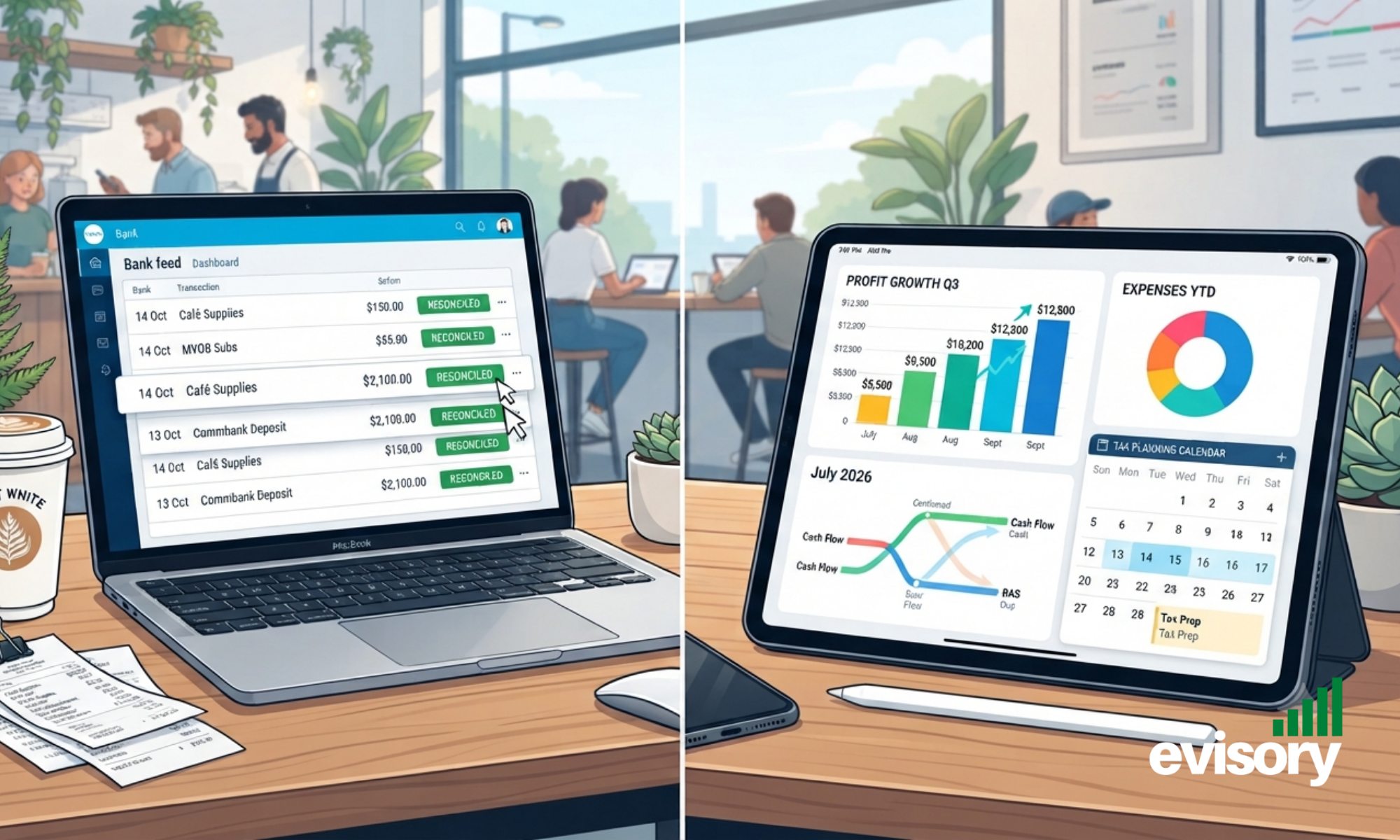
A split digital illustration contrasting everyday Xero data entry with high-level financial reporting and tax planning.
A bookkeeper in Xero records and controls transactions; a Xero accountant interprets the results and handles more complex compliance and planning.
Think of the split this way. If the question is, “Did this payment happen, and where should it be coded?”, that sits with bookkeeping. If the question is, “What does this trend mean for tax, margin or next quarter’s cash?”, that is usually accounting.
Side-by-side comparison of a Xero bookkeeper’s daily transaction tasks and a Xero accountant’s review, tax, reporting, and planning work.
Bookkeeping work commonly includes bank reconciliations, invoice entry, accounts payable, debtor follow-up, payroll processing and routine BAS preparation support. Accounting work usually adds management reporting, year-end adjustments, tax planning, cashflow forecasting, performance analysis and advice on structure or financing.
Hospitality blurs the line a little. A specialist team may treat bookkeeping as daily control work and accounting as an extension of that same workflow. That matters when supplier costs, payroll alignment and POS reconciliations all affect margin before month-end arrives.
What are the daily Xero tasks most businesses hand to a specialist?
The most common daily Xero tasks are transaction-heavy controls, not high-level advice.
In a venue or small business, these are the jobs that need consistency, speed and a sharp eye for exceptions.
Evisory or a similar hospitality-focused team handles recurring control work like POS reconciliations, payroll alignment and supplier cost checks where daily accuracy affects margin.
Bank reconciliations keep the Xero file current by matching feeds, clearing exceptions and spotting duplicates or missing entries.
Daily sales records capture POS totals, cash, merchant fees, tips and settlement timing correctly.
Accounts payable covers bill entry, coding, due dates and supplier statement matching.
Payroll processing records wages, super and leave movements so labour costs are visible quickly.
Accounts receivable tracks invoicing, incoming payments and overdue balances.
The pattern is simple: the more repetitive and transaction-dense the task, the more likely it belongs to bookkeeping. The more interpretive the task, the more it moves into accounting.
When should a Xero bookkeeper escalate work to a Xero accountant?
A Xero bookkeeper should escalate when a transaction affects tax treatment, business structure or a major performance decision.
The trigger is not just complexity. It is impact. If a venue buys equipment, signs a lease, changes entity structure, receives unusual grants, or starts seeing unexplained gross profit shifts, accounting input is needed. The file may still be technically reconciled, yet the business risk has changed.
BAS is a good example. A bookkeeper may prepare the numbers and clean the coding, but an accountant is better placed to review unusual GST treatment, year-end adjustments, loan structures or tax planning consequences. The same logic applies when wages look normal in Xero but prime cost keeps drifting.
A common mistake is waiting until year-end to ask for that review. If margin, GST or cashflow looks wrong in March, solving it in June is too late for most operating decisions.
How does a hospitality venue use Xero day by day?
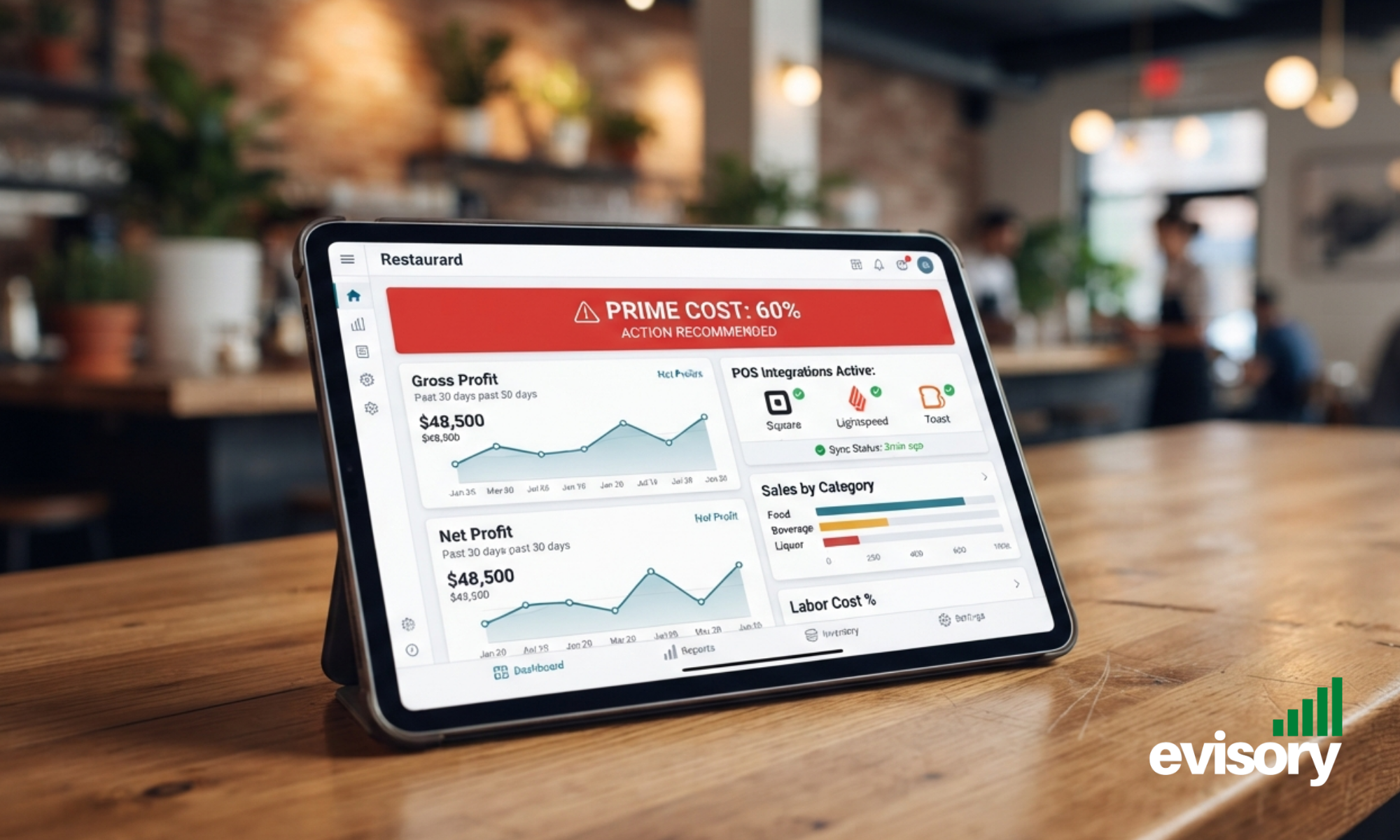
A tablet on a restaurant counter showing live financial data, showcasing integration between POS systems and Xero.
A hospitality venue uses Xero, Square or Lightspeed in a tight daily rhythm: capture sales, reconcile money, then review control metrics.
Step 1 is sales capture. The venue pushes daily POS data into Xero and uses clear account mapping and, where useful, tracking categories for channels, sites or departments. That keeps beverage, food and function revenue from blending into one unhelpful total.
Step 2 is reconciliation. Sales need to match not just the POS closeout, but also bank settlements, cash on hand, merchant fees, refunds and payroll timing. If those links are not checked, the day can look profitable while cash is quietly slipping.
"Evisory integrates Square or Lightspeed with Xero or QuickBooks to track metrics automatically."
Step 3 is review. The next morning, management should be able to see revenue, gross profit and labour pressure fast enough to act. Evisory’s hospitality guidance points to a practical threshold here: if daily Prime Cost is above 60%, roster or ordering changes should happen the next day, not next month.
That is why daily bookkeeping matters so much in venues. It is not admin for its own sake. It is the operating system for tomorrow’s decisions.
Is BAS work in Xero bookkeeping or accounting?
In Australia, BAS work in Xero usually starts in bookkeeping and finishes with accounting or registered agent oversight when complexity rises.
The bookkeeping side includes coding GST correctly, reconciling sales and expenses, checking control accounts and preparing the underlying data. That is the labour-intensive part. If those records are wrong, the BAS will be wrong no matter who reviews it later.
The accounting side becomes important when GST treatment is not routine, when adjustments are needed, or when the BAS affects broader tax planning and cashflow decisions. An ATO Community discussion reflects this practical split by framing BAS preparation in Xero as something a bookkeeper can prepare but not necessarily lodge.
A common misconception is that BAS is only quarterly compliance. It is also a health check. If GST swings sharply without a clear business reason, the issue may be coding, timing, stock movement or sales integrity rather than tax alone.
How do you set up a clean Xero workflow from POS to payroll?
A clean Xero workflow starts with source-system mapping, then daily reconciliation rules, then exception reporting.
Step 1 is mapping. Connect the POS, merchant facility, payroll platform and bank feeds properly. Decide which accounts will hold sales, clearing balances, merchant fees, wages and super. If the mapping is vague, every later report becomes harder to trust.
Step 2 is rhythm. Set a daily or at least several-times-per-week routine for bank reconciliations, sales posting and payroll checks. High-volume hospitality businesses rarely stay accurate with a once-a-month cleanup approach.
Step 3 is exception control. Review unmatched settlements, negative stock patterns, abnormal supplier costs and wage-to-sales spikes. Pro tip: do not post POS sales net of merchant fees if you want clear settlement reconciliation. Gross sales and fees should be visible separately, or margin analysis gets distorted.
This is where a specialist Xero accountant or bookkeeper can save time. The software itself is not the issue. The discipline of the workflow is.
What changes when you need cashflow forecasting and management reporting?

Once you need cashflow forecasting and management reporting, the Xero accountant becomes much more important.
Bookkeeping tells you what happened. Accounting tells you what it means and what happens next if current patterns continue. That shift matters when payroll is rising faster than revenue, supplier terms are tightening, or a seasonal dip will land just before BAS or super payments are due.
Highlighted quote stating that bookkeeping shows what happened while accounting explains what it means and what happens next.
In a stronger setup, the bookkeeping file feeds into accountant review rather than sitting alone. Evisory describes this model clearly: bookkeeping is reviewed by an accountant who produces a monthly report on business strengths and weaknesses, supported by a one-page dashboard covering revenue, gross profit and commentary.
"Evisory combines bookkeeping with an accountant-reviewed monthly report and a one-page dashboard covering revenue, gross profit and expert commentary."
That kind of reporting changes the conversation. Instead of asking whether Xero is reconciled, owners can ask whether labour is running ahead of target, whether price rises are sticking, and whether cash will cover the next 30 to 60 days without stress.
How do you choose between a Xero bookkeeper, a Xero accountant, or one integrated team?
Choose based on the problem you need solved, not on the software label.
A lot of businesses ask for a Xero accountant when they actually need transaction control first. Others hire bookkeeping help when the real issue is falling margin or poor cash planning.
Choose bookkeeping first: if the Xero file is behind, bank reconciliations are incomplete, or payroll and sales are not lining up.
Choose accounting first: if the books are current but tax, structure, pricing, funding or profitability decisions are the real pressure point.
Choose an integrated team: if your venue has high transaction volume, POS complexity, shifting rosters and tight cash conversion.
Choose monthly review support: if you still handle daily entries internally but want accountant oversight on trends and compliance risk.
There is a trade-off. A single provider can reduce handoff errors and speed up decisions, while separate specialists can work well if roles are tightly defined. In hospitality, integrated support often wins because the cost of delay is high when wages, supplier costs and daily sales move fast.
What mistakes make daily Xero work look accurate when it is not?
The biggest Xero mistakes are usually timing, coding and reconciliation errors that still leave the file looking tidy.
These are the ones that cause the most confusion:
Bank reconciled, but POS not reconciled
Sales posted as lump sums with no merchant fee split
Payroll entered without checking labour against revenue
Supplier credits or rebates left out
Default GST codes used without review
A tidy Xero dashboard can still hide weak controls. If settlements arrive two days after trade, daily cash can look stronger than it really is. If payroll is posted correctly but never compared with sales, labour blowouts can hide in plain sight. If tracking categories are missing, an accountant may see total revenue growth while one part of the venue is quietly losing margin.
That is why the question is not only “bookkeeper or accountant?” It is whether your Xero process turns raw transactions into decisions quickly enough to protect profit.