
Best Cash Flow Forecasting Tools for Hospitality Teams
Cash flow forecasting is not just a finance exercise for hospitality teams. For cafés, bistros with a bar, pubs and restaurants, it is the operating system that tells you whether next month’s wages, BAS and supplier runs will clear without strain.
The best cash flow forecasting tools for hospitality teams are the ones that update weekly, track seasonal trends, and connect sales data, payroll, BAS, supplier payments and bank timing in one view.
For many Australian venues, a strong setup is Xero or MYOB for core accounting, paired with a rolling 13-week cash flow forecast and scenario planning for quiet weeks, public holidays and stock-heavy periods.
Official guidance from business.gov.au treats a cash flow statement as a forecasting tool for future sales, costs, shortages and surpluses, not just a historical report.
ABS data shows accommodation and food turnover can move sharply month to month, including a 5.0 per cent rise in December 2022 after a 2.7 per cent fall in November 2022, so static monthly averages are risky.
If your venue has POS complexity, penalty rates, multiple payment channels or weak visibility over daily cash, specialist hospitality support matters as much as the software itself.
The best tools are the ones that update often, reflect seasonality, and connect sales data to real payment timing. If your venue wants that discipline without building and maintaining the whole process in house, Evisory combines hospitality bookkeeping, accounting, POS reconciliations, management reporting and profit-focused advisory to turn forecasts into weekly decisions.
What makes a cash flow forecasting tool good for hospitality teams?
The best hospitality cash flow forecasting tools combine Xero or MYOB data with venue-specific timing for sales, wages, tax and supplier payments. A good tool predicts shortfalls before they hit the bank.
Highlighted quote reading: “A good tool predicts shortfalls before they hit the bank.”
Business.gov.au calls a cash flow statement one of the most important tools in managing business finances, and that matters even more in hospitality because cash moves faster than in many other sectors. Card settlements may land after the sale, wages may spike on weekends and public holidays, and supplier invoices often bunch around stock ordering cycles.
The strongest tools do three jobs well: they show current cash, estimate future inflows and outflows, and update regularly enough to catch seasonal trends and cycles. A common mistake is picking software based on dashboard design alone. If the forecast does not reflect payroll timing, GST, POS clearing and supplier terms, it looks neat but makes weak decisions.
"Evisory includes POS reconciliation as standard, which matters when hospitality sales, deposits and actual bank timing do not match cleanly."
Why is seasonality so important in hospitality cash flow forecasting?
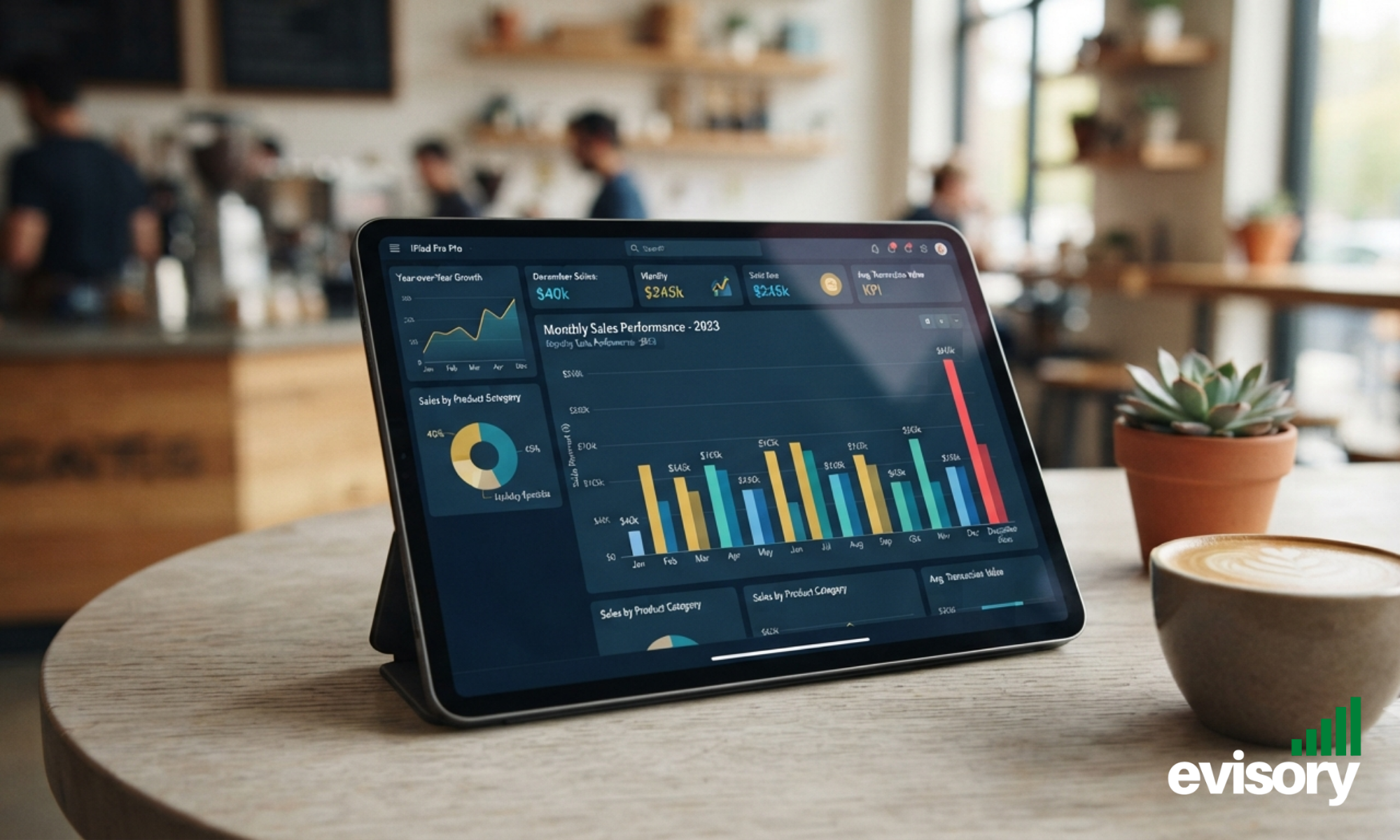
A dashboard showing seasonal sales patterns, demonstrating the volatile monthly cash flow cycles in Australian dining.
Seasonality is a hard fact in hospitality, and ABS plus business.gov.au both support tracking it directly. A static forecast built on average monthly sales will miss real cash pressure.
ABS reported that accommodation and food services turnover rose 5.0 per cent in December 2022 after a 2.7 per cent fall in November 2022. Food and beverage services led that rise as Australians moved into the holiday season. That kind of swing can change staffing, stock purchases and cash holdings within weeks.
The practical lesson is simple. If your café or bistro with a bar trades strongly in December, weakly in late January, and differently again over Easter or school holidays, your forecast needs weekly pattern recognition, not just annual optimism. Tourism research from the University of the Sunshine Coast also points to strong seasonality in demand, which is why time-series methods that account for seasonal properties are more reliable than flat-line models.
Pro tip: use last year’s same-week pattern as a starting point, then adjust for price changes, trading hours, events and staffing.
What are the best cash flow forecasting tools for hospitality teams?
For most Australian venues, the best cash flow forecasting tools are Xero, MYOB, Float, Fathom and a disciplined spreadsheet model. Evisory can also act as the managed forecasting layer when software alone is not enough.
No single product wins for every venue. The right choice depends on site count, POS complexity, reporting frequency and whether your team can maintain assumptions accurately each week.
Evisory-managed forecasting stack: Best when a venue wants specialist hospitality bookkeeping, POS reconciliation, weekly transparency reporting and advisory wrapped around the software rather than relying on software alone.
Xero: Strong for cloud accounting, bank feeds, app integrations and a practical base for rolling forecasts in small to mid-sized venues.
MYOB Business: A solid fit for Australian businesses that want payroll and accounting in one ecosystem with familiar local workflows.
Float: Useful when you want a dedicated cash flow forecasting layer with scenario planning and rolling forward visibility.
Fathom: Better suited to venues that want deeper management reporting, KPI analysis and board-style visibility across multiple entities.
Excel or Google Sheets with a business.gov.au-style template: Best for operators who need flexibility, custom timing logic and low software cost, provided someone maintains the model carefully.
If your venue runs one site and the owner still knows every supplier due date, a spreadsheet may be enough. If you are juggling multiple sites, heavy payroll, frequent stock orders and patchy visibility, a managed forecasting process often creates more value than buying another app licence.
How do spreadsheet forecasts compare with cloud forecasting software?
Spreadsheets are flexible and cloud tools are faster, but neither is automatically better. Excel and Xero solve different problems.
A spreadsheet is strong when your venue has irregular cash timing that needs custom logic. You can model keg purchases, event deposits, merchant clearing delays, fit-out spending and one-off tax payments exactly how they occur. The trade-off is maintenance risk. One broken formula or old assumption can distort the whole forecast.
Cloud forecasting tools are better when speed, collaboration and rolling updates matter most. They pull live accounting data, reduce manual entry and help owners check forecast versus actual performance more often. Still, software does not remove the need for judgement. If sales assumptions are wrong, the output stays wrong.
A useful rule is this: if the business reviews cash weekly and has stable systems, cloud tools usually win. If the venue has unusual trading patterns or is in turnaround mode, start with a tight custom model and then automate later.
How do you build a 13-week cash flow forecast for a café or bistro with a bar?
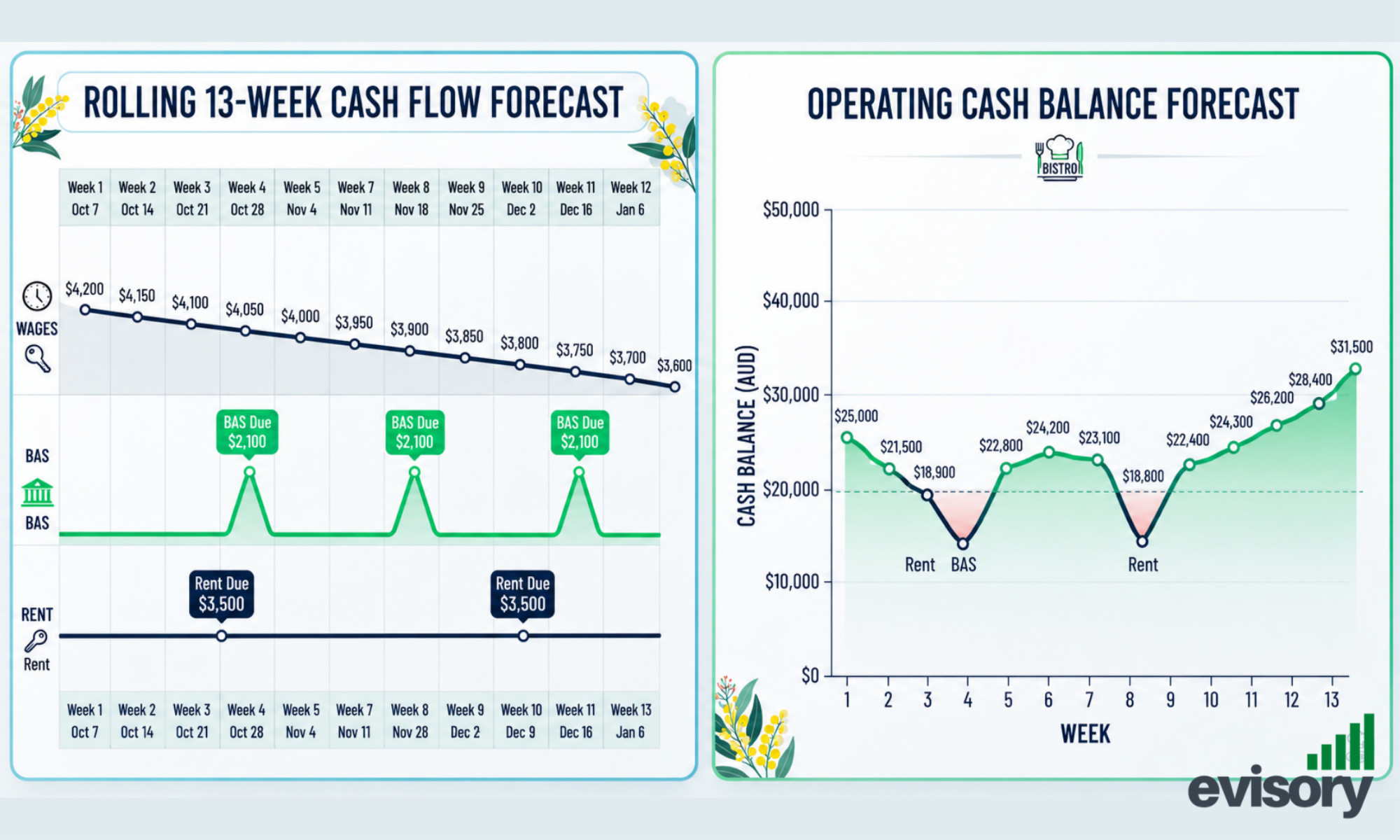
Digital illustration of a rolling 13-week cash flow timeline highlighting major upcoming hospitality payment cycles.
A 13-week cash flow forecast is the most practical format for hospitality because it matches operational rhythm. Xero data and POS data should feed it every week.
Start with actual bank cash, not profit. Then map what will hit the bank in and out over the next 13 weeks, using known payment dates rather than broad monthly estimates.
Set the opening cash balance: Use cleared bank cash at the start of week one.
Forecast cash in: Split dine-in, takeaway, bar, functions, gift cards and other receipts by expected bank timing.
Forecast cash out: Add wages, super, rent, BAS, loan repayments, merchant fees, supplier payments and owner drawings.
Add timing rules: Enter exact payment weeks for tax, rent, lease, insurance and major stock buys.
Review weekly: Compare forecast to actuals, then roll the model forward one more week.
The real value comes from variance review. If labour was 4 points above plan or card settlements landed later than expected, fix the assumption straight away rather than waiting for month-end accounts.
Five-step cash flow forecasting process for a hospitality venue, from opening bank cash to weekly variance review.
"Evisory provides weekly transparency reporting, helping hospitality teams spot cash pressure before payroll, BAS or major supplier runs."
How do you forecast payroll, BAS, and supplier payments accurately?
Accurate forecasting depends on payment timing, not just expense totals. Wages, BAS and suppliers are where many hospitality forecasts fail.
Payroll needs special care in venues because public holidays, overtime, split roles and penalty rates can move quickly. BAS creates a separate spike because GST and PAYG withholding do not leave the bank evenly across the month unless you plan for them. Supplier payments can also bunch after a stock-heavy week, which makes profitable trade feel cash-poor.
Map wages by roster cycle: Use rostered hours, award rates, public holidays and expected turnover, not last month’s payroll average.
Schedule statutory payments: Enter BAS, super and payroll-related obligations in the exact week they are due.
Group suppliers by terms: Separate COD, 7-day and 30-day suppliers so you can see payment clusters.
Create a tax holding rule: Move a set share of daily takings into a separate view or account so GST and PAYG do not surprise you later.
A common misconception is that payroll is predictable because rosters are planned. In hospitality, labour cost moves with weather, events, no-shows and last-minute cover, so the forecast must stay live.
How do cash flow forecasting tools compare for single-site venues versus multi-site groups?
Single-site venues need simplicity, while multi-site groups need control and consolidation. Xero and Fathom often suit different stages.
A single café or bistro with a bar usually benefits from a short operating model: daily sales, weekly wages, supplier timing and tax obligations. The owner often needs a fast answer to one question: how much cash is safe to spend this week? Too much software can slow that down.
A multi-site group faces different issues. Intercompany transfers, different rent cycles, central payroll, site-by-site stock patterns and management reporting all matter. In that case, a dedicated reporting layer or external advisory support can be worth it because the business needs both site detail and group cash visibility.
If one site routinely funds another, the forecast should show that clearly. If not, head office may think group cash is healthy while one venue is close to a shortfall.
How do you stress-test a forecast with scenario planning?
Two professionals reviewing scenario stress-tests on a laptop to plan for unexpected cash flow drops in a food venue.
Scenario planning is one of the most useful upgrades for hospitality forecasting. The ATO’s Digital Cash Flow Coaching Kit supports this approach alongside accounting software.
A base forecast is only the starting point. Teams should also test what happens if sales soften, wages rise, or suppliers demand faster payment. That lets you act early rather than borrowing late.
Build a base case: Use your most likely sales, wage and payment assumptions.
Build a downside case: Reduce sales, delay receivables if relevant, and lift labour or stock costs.
Build a recovery case: Add actions like tighter rostering, smaller stock buys, menu price changes or deferred capex.
Set action triggers: Decide in advance what happens if cash drops below a threshold, such as roster changes or supplier renegotiation.
This is where hospitality-specialist support helps. Forecasting is not only about calculation. It is also about deciding which lever to pull first when the downside case starts to look real.
Which cash flow forecasting mistakes cause the biggest surprises?
The biggest surprises usually come from timing errors, not maths errors. BAS, payroll and merchant settlement timing create more trouble than most venues expect.
Business owners often say the P&L looked fine, yet cash still tightened. That usually means the forecast tracked expenses by month but not by payment date, or it ignored seasonal shifts that were already visible in prior-year trading.
Using monthly averages: This hides weekly pressure around wages, rent and tax.
Ignoring merchant settlement timing: Card sales are not always same-day bank cash.
Treating profitable weeks as free cash: GST, PAYG and supplier payments may already be spoken for.
Leaving out one-off costs: Insurance, repairs, licence renewals and equipment deposits can hit hard.
Failing to compare forecast versus actual: A forecast without weekly correction becomes a guess.
A useful misconception to drop is this: “We are busy, so cash will be okay.” Busy trading can increase stock, labour and tax faster than cash clears.
When should a hospitality team get outside help with cash flow forecasting?
Outside help is worth it when the forecast drives payroll, tax and supplier decisions but your internal process is inconsistent. Evisory is built for that gap in hospitality.
If your team is still forecasting from memory, checking cash only when the bank balance looks light, or struggling to reconcile POS sales to bank deposits, specialist support can change the quality of every decision. That is especially true for cafés and bistros with a bar, where sales channels, staffing patterns and stock purchases move quickly.
Evisory’s role is practical rather than theoretical: hospitality bookkeeping, accounting, payroll support, POS reconciliations, management reporting and cashflow advisory in one Brisbane-based service. That means venue owners get clear numbers, a single point of contact and fixed-price options, without needing to piece together advice from separate providers. If your current tool is fine but the process is weak, that is often the best moment to bring in help.
"Evisory gives Brisbane hospitality venues a single point of contact across bookkeeping, accounting, POS reconciliations and profit-focused advisory."
If you want better forecasts without building another internal admin burden, a specialist hospitality bookkeeping firm and accounting firm can set the cadence, maintain the numbers and help your team act on them each week.