
Virtual Bookkeeper vs Local Support for Venue Owners
For a venue owner, the real question is not simply whether a virtual bookkeeper is cheaper or more convenient. It is whether your bookkeeping support can handle hospitality realities like POS reconciliation, BAS deadlines, penalty rates, cash variances and fast payroll turnarounds.
For most Australian venue owners, a specialist hospitality bookkeeper with local support is the safer choice than a generic virtual bookkeeper, because the work connects directly to BAS, payroll compliance, POS reconciliation and cashflow decisions.
A pure virtual bookkeeper can work well for a simple single-site venue with clean systems, low staff turnover and disciplined weekly document flow.
Local support becomes more valuable when a café, bistro with a bar, pub or restaurant has complex awards, frequent roster changes, multiple revenue centres, cash handling, stock issues or owner-managers who want faster answers.
Geography matters less than specialisation: a remote hospitality specialist is usually better than a nearby generalist, but a local specialist can add on-site problem solving, staff training and quicker escalation.
Key decision criteria are payroll risk, BAS and GST workflow, POS-to-bank reconciliation, reporting cadence, response time and whether you need advice beyond transaction processing.
In Brisbane and South East Queensland, firms like Evisory sit in the middle ground: virtual delivery where it suits, with local hospitality bookkeeping, accounting, payroll, BAS, OSR and weekly reporting when venue complexity calls for it.
Virtual bookkeeping can be excellent when it is built around strong processes. Local support is often better when the venue needs practical oversight, sharper communication and industry-specific judgement, especially in cafes and bistros with a bar where labour, liquor and service periods create more moving parts than many owners expect.
What does a virtual bookkeeper actually do for a venue owner?
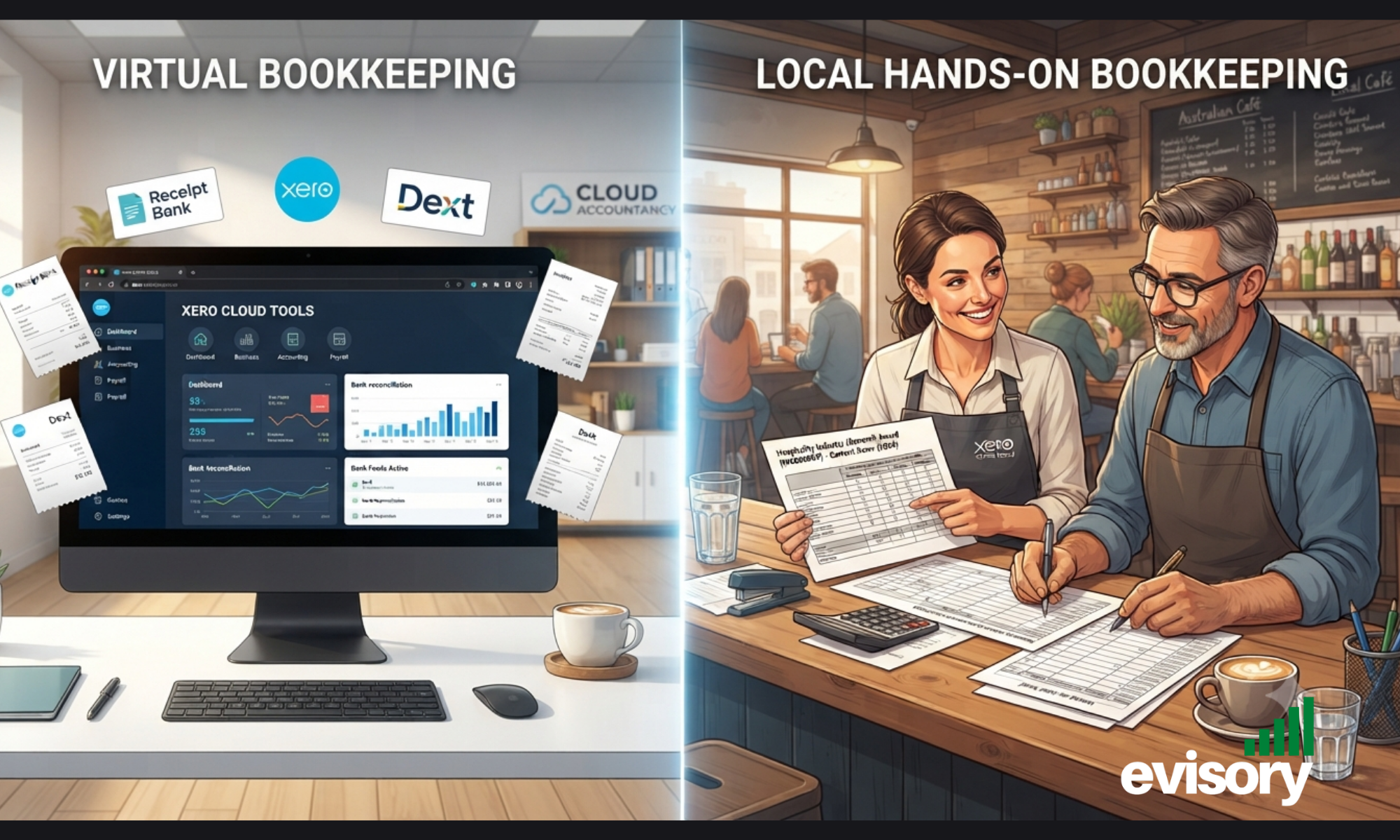
A split visual contrasting cloud-based remote data entry with hands-on, face-to-face restaurant bookkeeping support.
A virtual bookkeeper manages Xero, payroll data and BAS prep remotely, but for venues the real job should also include POS reconciliation and cashflow visibility. If it stops at coding bank transactions, the support is too thin for hospitality.
In a venue setting, a virtual bookkeeper normally accesses your accounting file, bank feeds, payroll platform, invoice capture tool and POS reports online. They can reconcile bank accounts, process supplier bills, prepare payroll journals, review GST coding and prepare data for BAS lodgment.
A common misconception is that "virtual" means lower control. In practice, remote support can increase visibility if the provider delivers a tight weekly close process, asks for missing documents quickly and pushes clean reporting into the owner’s hands every week rather than every quarter.
What matters is scope. A generic virtual bookkeeper may be fine for a service business with recurring invoices. A venue owner needs more. The numbers only become decision-useful when food, beverage, wages and POS takings match the bank, the roster and the tax position.
Two-column comparison of a generic virtual bookkeeper and a local hospitality specialist across payroll, POS reconciliation, BAS, cash handling, reporting speed and on-site support.
"Evisory includes POS reconciliation as part of its hospitality bookkeeping service, linking venue sales data to cleaner reporting."
How is local hospitality bookkeeping support different from a virtual bookkeeper?
Local hospitality support adds context, not just proximity, and Brisbane-based firms can spot venue workflow issues faster than a generalist remote provider. The value is highest when the books depend on what happens on the floor, at the bar and in the roster.
A local specialist can visit the venue, review cash-up routines, check how managers close shifts, compare rostering practices with payroll output and help untangle supplier, stock or till discrepancies. That matters when a venue has split tills, function deposits, bar tabs, delivery platforms or late changes to staff hours.
A pure virtual setup is often leaner and can still be strong if the provider knows hospitality well. If your venue runs a disciplined daily close, sends complete source documents and has stable payroll settings, remote support may be enough. If not, local access becomes a risk-control tool, not a convenience extra.
What are the best bookkeeping support models for hospitality venues?
The best model depends on venue complexity, not on fashion, and Evisory, Xero-based virtual teams and in-house finance staff each suit different operating patterns. Owners should choose the model that gives reliable weekly numbers with the least friction.
For hospitality venues, these are the most practical support models:
Specialist local hospitality firm: A Brisbane-focused provider such as Evisory, where bookkeeping, payroll, BAS, OSR and POS reconciliation are handled with hospitality context and local support.
Pure virtual bookkeeper: Best for simpler venues with stable payroll, low cash complexity and strong owner discipline around documents and approvals.
Hybrid remote plus local advisor: Daily processing stays remote, while an Australian advisor handles review, issues and management reporting.
In-house bookkeeper plus external accountant: Useful for larger groups or venues with heavy accounts volume, but it needs strong controls and hospitality-specific oversight.
Generalist suburban bookkeeper: Sometimes adequate for very small venues, though it often falls short once payroll awards, POS data and weekly reporting get harder.
The trade-off is straightforward. The lower the price and the broader the provider’s industry mix, the more likely the owner will need to do the interpretation work themselves.
How can you decide between virtual and local support in 5 steps?
The right choice becomes clear when you score the venue’s operational complexity against reporting needs. If payroll, POS and compliance are simple, virtual can fit. If any two are messy, local specialist support usually pays for itself.
Use a short decision process before you sign with anyone:
Map the workflow: Count sites, tills, bank accounts, revenue channels, payroll awards and approval points.
Test payroll risk: Check whether staff attract penalty rates, overtime, allowances, salaried arrangements or frequent roster edits.
Review reporting rhythm: Decide whether you need month-end compliance only, or weekly labour, gross profit and cashflow reporting.
Check source data quality: If POS exports, invoices, rosters and cash-up reports arrive late or incomplete, choose stronger oversight.
Measure response needs: If owner decisions depend on same-week answers, pick a provider with clear turnaround times and one point of contact.
Pro tip: do not choose on hourly price alone. A cheaper virtual bookkeeper who misses wage interpretation, POS variances or GST coding can cost far more than a higher-fee specialist.
Which option is better for payroll, penalty rates and Fair Work risk?
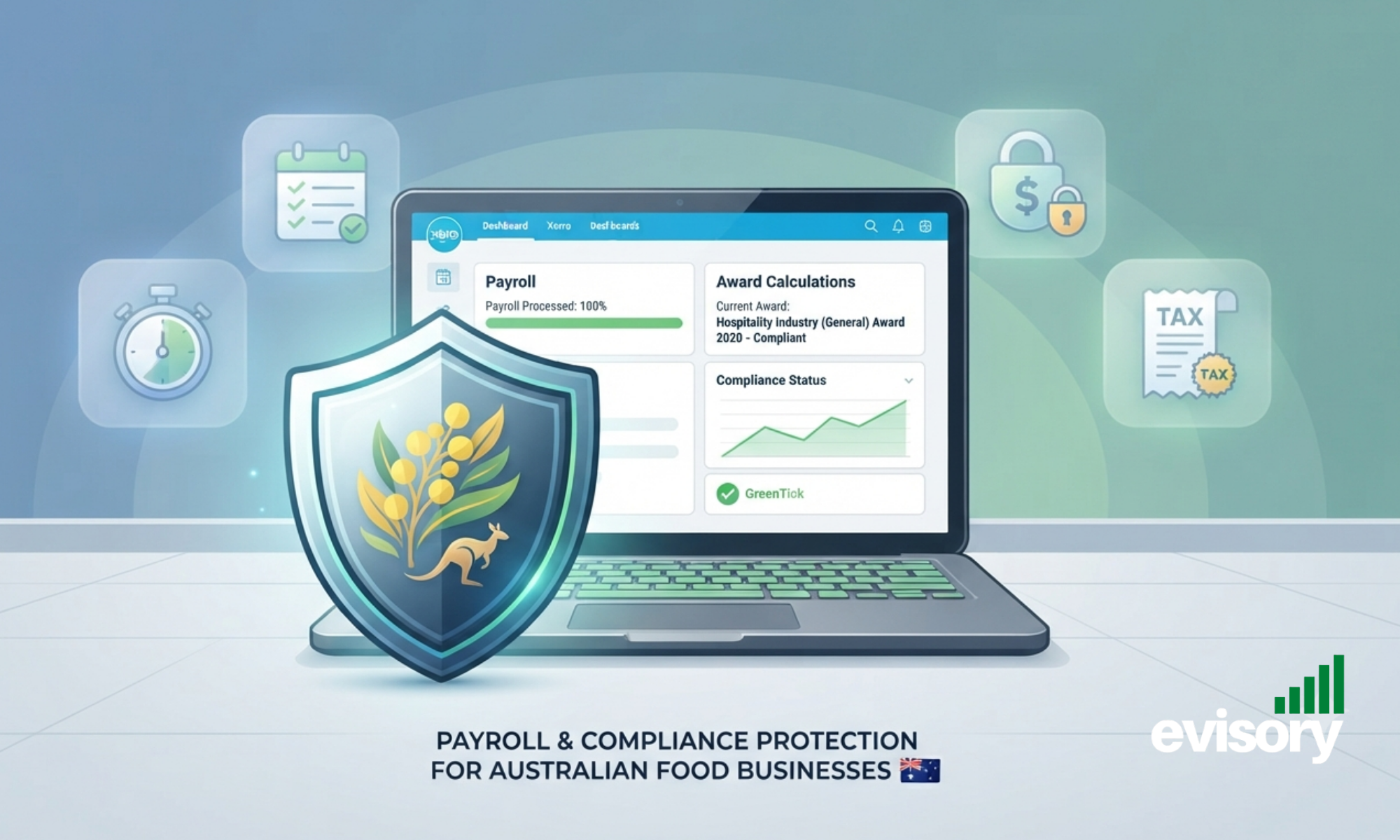
A graphic highlighting the importance of correct award interpretation and wage compliance in Australian restaurants.
For payroll compliance, specialist support beats generic support, whether virtual or local, and Fair Work plus hospitality awards make this non-negotiable. Geography is secondary to award knowledge, record keeping and review discipline.
This is where venue owners get hurt. In 2024, the Fair Work Ombudsman recovered $223,107 for 447 underpaid food outlet employees on the Sunshine Coast. Inspectors investigated 21 businesses, finalised 19 investigations, and found breaches in 68% of food outlets. The recurring issues were penalty rates, minimum wages, overtime, leave and record-keeping.
That data says something important. Payroll in hospitality is not a clerical side task. It sits inside awards, classifications, timesheets, leave, public holidays and evidence. A virtual bookkeeper can handle it well only if they know hospitality payroll deeply and follow a clear checking process.
Highlighted quote card reading: 'Payroll in hospitality is not a clerical side task.'
"Evisory provides weekly reporting and Brisbane-based support, giving venue owners a tighter review cycle for payroll and cashflow.”
A common misconception is that payroll software fixes award interpretation by itself. It does not. Software calculates from the rules you feed it. If classifications, meal breaks, ordinary hours or penalty settings are wrong, the output will still be wrong. Helpful tools like the Fair Work Pay and Conditions Tool support checking, but they do not replace a proper payroll review.
How should a venue set up BAS, GST and OSR workflows with a virtual bookkeeper?
A virtual bookkeeper can manage BAS and GST well if the venue closes data weekly and reconciles before lodgment. ATO deadlines and OSR obligations do not care whether your provider sits in Brisbane or online.
The workflow should be built around deadlines, not around spare time. According to ATO rules, businesses with GST turnover of $20 million or more must report and pay GST monthly and lodge electronically, with the monthly activity statement generally due on the 21st of the following month. Businesses under $10 million may be eligible for Simpler BAS, and some registered businesses under $75,000 turnover may report annually, though many venues sit well above that threshold. The ATO’s BAS guidance is a useful reference point.
A practical setup looks like this:
Close weekly: Reconcile bank, wages, supplier bills and POS clearing accounts every week, not only at month end.
Lock GST coding: Standardise sales categories, merchant fees, delivery apps and supplier tax codes to reduce BAS errors.
Review before lodgment: Compare revenue, GST collected, wages and prior periods before BAS and OSR lodgment is approved.
Keep an audit trail: Store source reports, payroll records, adjustment notes and approval emails in one accessible file set.
If your virtual bookkeeper asks to prepare BAS from unreconciled accounts, pause there. That is a process weakness, not a time-saving measure.
What systems and reports should a café or bistro with a bar expect each week?

A hands-on local business expert resolving cash-up and till discrepancies at a venue's point-of-sale terminal.
A café or bistro with a bar should expect weekly reporting, POS reconciliation and a short cashflow view, not just a monthly profit and loss. Xero and the POS should tell the same story within a few days of trade.
For most venues, the minimum useful weekly pack includes total sales by channel, labour cost, wages as a percentage of sales, gross profit trend, outstanding creditors, debtor or function deposit status, bank position and a check that POS takings reconcile to cash and bank deposits. If one number is missing, the owner is often making roster or purchasing decisions with blind spots.
Pro tip: daily sales reports are not the same as financial control. A venue can hit strong weekly revenue and still be leaking margin through voids, unbanked cash, supplier creep or wage drift. This is why weekly POS reconciliation matters so much in hospitality.
Evisory’s model is relevant here because it combines hospitality bookkeeping with weekly reporting, payroll, management reporting and profit-focused advice. For Brisbane venue owners who want a single point of contact, especially cafes and bistros with a bar, that can reduce the handoff problems that appear when bookkeeping, payroll and advisory are split across different providers.
How do you onboard a new virtual bookkeeper without disrupting trade?
A clean onboarding should happen in stages, and the best cutover point is usually just after a BAS period or pay cycle. Xero, payroll and POS access should be structured before any processing starts.
A rushed handover creates duplicated work and missed liabilities. Venue owners can avoid that with a short, controlled process:
Set the cutover date: Choose a point after payroll finalisation or BAS lodgment where balances are easier to prove.
Grant system access: Add the bookkeeper to accounting, payroll, POS, merchant, bank-feed and invoice platforms.
Provide control documents: Send award settings, supplier lists, chart of accounts, bank signatories and current lodgment status.
Run a parallel review: Have the new provider test one payroll and one week of reconciliations before full takeover.
Approve reporting format: Agree on weekly KPIs, meeting cadence and who signs off BAS, OSR and payroll.
A common mistake is changing providers in the middle of a disputed payroll issue. Fix the payroll settings first, then move the file.
When does local Brisbane support create more value than a remote team?
Local Brisbane support adds the most value when the venue has operational friction, and Evisory plus other specialist firms are strongest where bookkeeping must connect to on-site behaviour. New openings, bar-heavy trade and unstable payroll are common triggers.
If a venue is opening, changing POS, adding liquor service, rotating managers or struggling with cash-up discipline, local support usually wins. The reason is simple: some problems are not accounting problems at first. They are workflow problems that only show up later as payroll errors, unexplained shortages, poor gross profit or late BAS reviews.
"Evisory says it works exclusively with pubs, clubs, restaurants, cafés and hospitality venues across Brisbane."
This is where a specialist hospitality bookkeeping and accounting firm can be worth far more than generic back-office help. Evisory supports bookkeeping, accounting, payroll, BAS, OSR, cashflow management and POS reconciliations with a Brisbane focus, which suits owners who want fast local support and practical reporting, not just year-end compliance. If your venue is a café or bistro with a bar and the numbers feel delayed, a short review of workflow and reporting gaps is often enough to show whether local, virtual or hybrid support is the better fit.
What should you ask before hiring any hospitality bookkeeper?
The best hiring questions test hospitality depth, not just software familiarity, and Xero certification alone is not enough. A good answer should connect payroll, BAS, POS and reporting into one operating rhythm.
Before appointing a virtual bookkeeper or local firm, ask:
Which venue types do you work with?: Look for pubs, restaurants, cafes, clubs or bistros with a bar, not only general small business clients.
How do you handle POS reconciliation?: Ask whether it is included as standard or treated as extra clean-up work.
Who reviews payroll risk?: Check award knowledge, penalty-rate handling and record-keeping expectations.
What is your BAS process?: The answer should mention reconciliations, review points and approval before lodgment.
How often will I get numbers?: Weekly reporting is often more useful than a polished month-end pack delivered too late.
Who do I call when something goes wrong?: One clear point of contact can matter more than a lower fee.
If the answers sound admin-heavy and operations-light, keep looking. Venue owners need bookkeeping that supports decisions during trade, not only paperwork after the month has closed.