
Outsourced Bookkeeping vs In-House for Hospitality Venues
Hospitality venues rarely struggle with basic data entry alone. The real pressure sits in payroll, GST coding, BAS timing, POS reconciliation, BAS preparation, and getting numbers quickly enough to act on them.
For most Australian hospitality venues, outsourced bookkeeping is the better choice when the work includes BAS, payroll, Single Touch Payroll, GST coding and POS reconciliation, because those tasks need specialist handling rather than simple transaction entry.
In-house bookkeeping gives immediate access and venue context, but outsourced bookkeeping usually reduces key-person risk, improves compliance depth and makes month-end reporting more consistent.
If your venue is registered for GST, you must lodge BAS, and if you employ staff, you must report tax and super through STP-enabled software; outsourcing can help, but the provider must be properly qualified for BAS services.
Tax Practitioners Board guidance treats payroll services, STP reporting, activity statement preparation and ATO dealings on BAS matters as BAS services, while plain bank reconciliations and basic data entry are not BAS services.
A hybrid model often works best for cafes, bistros with a bar, pubs and restaurants: keep approvals and on-floor operational inputs in-house, outsource compliance-heavy bookkeeping, payroll and reporting to a specialist.
If you want clearer weekly numbers, fewer payroll surprises and cleaner cashflow decisions, a hospitality specialist such as Evisory is usually a better fit than a generalist bookkeeper.
That matters more in hospitality than in many other sectors. Labour is large, margins are thin, and one bad pay run or mis-coded GST batch can distort wage percentages, stock margins and cashflow at the same time.
What is outsourced bookkeeping for hospitality venues?
Outsourced bookkeeping means a venue gives recurring finance work to a specialist provider such as Evisory while keeping trading decisions and approvals in-house. In hospitality, the valuable part is rarely data entry alone. It is the mix of payroll, supplier processing, POS reconciliation, BAS preparation and management reporting.
A cafe or bistro with a bar generates more accounting friction than a simple retail shop. You may have split tenders, tips, surcharges, cash variances, supplier credits, rosters across multiple classifications and different GST treatments across sales and purchases. That is why outsourced bookkeeping in hospitality tends to work best when it is built around venue systems, not just bank feeds.
"Evisory works exclusively with pubs, clubs, restaurants, cafés and hospitality venues across Brisbane."
One common misconception is that outsourcing bookkeeping simply means sending receipts to a generic offshore data entry team. In Australia, once the work moves into GST interpretation, BAS preparation, payroll tax treatment or STP reporting, the compliance standard changes and the provider’s qualifications matter.
How does outsourced bookkeeping compare with in-house bookkeeping?
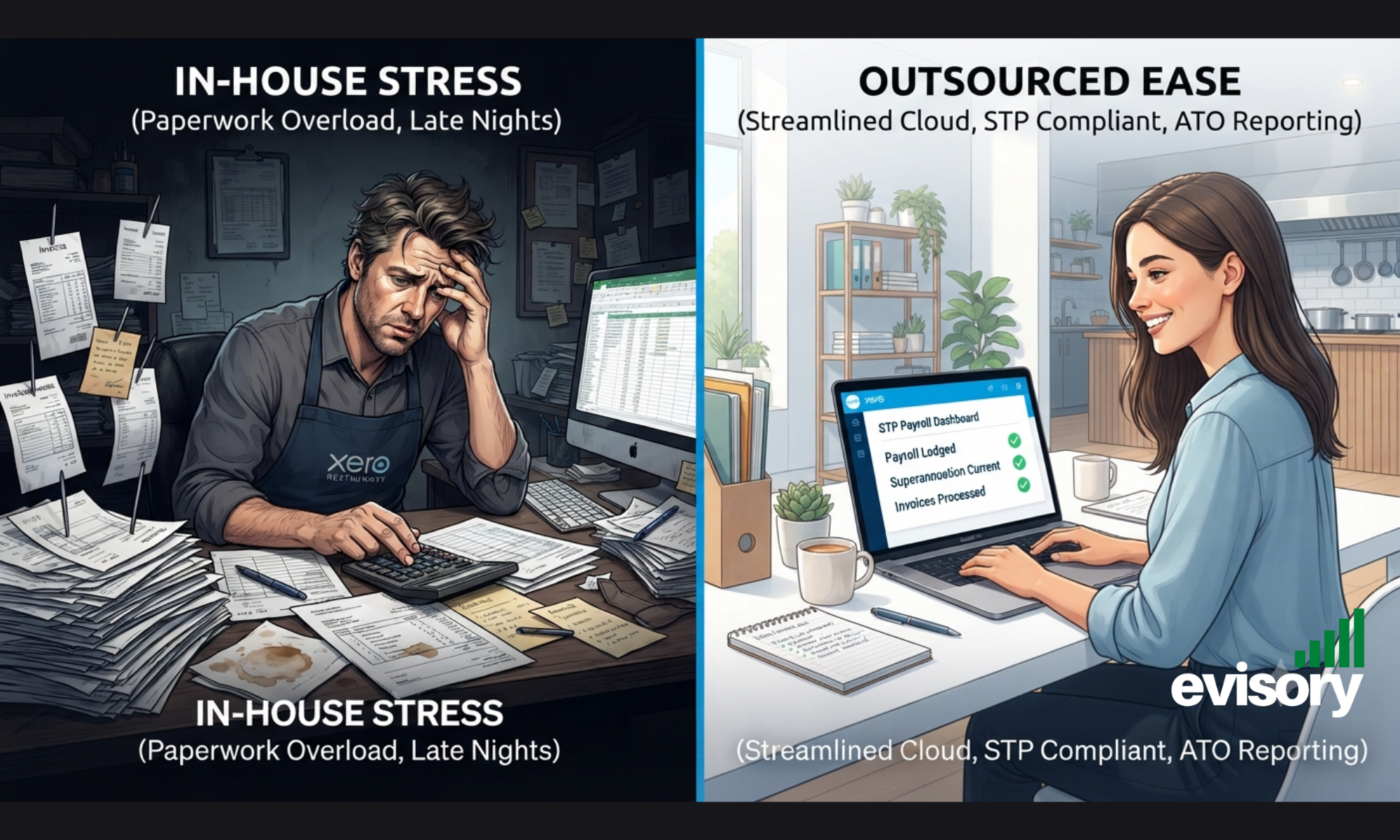
A split visual contrast highlighting the stress of in-house paperwork versus the efficiency of modern cloud bookkeeping
Outsourced bookkeeping usually wins on specialist compliance depth, while in-house bookkeeping wins on immediate venue context. A hybrid model is often strongest for Brisbane venues because it combines floor-level knowledge with registered BAS or tax expertise.
An in-house bookkeeper can spot operational issues quickly. They hear about voids, walkouts, broken POS terminals and staff swaps in real time. That can be useful when yesterday’s trading needs explaining today.
The trade-off is coverage and technical range. If one internal person handles payroll, creditor runs, BAS prep and bank reconciliations, annual leave, sick leave or resignation can create a gap fast. Outsourced teams spread that risk and often bring stronger system discipline around month-end close, payroll checks and reporting cadence.
A second trade-off is independence. In-house teams can be pulled into admin tasks that have little to do with financial control. Outsourced specialists are more likely to protect the month-end process, question anomalies and push for clean POS-to-bank matching. That discipline is a big reason hospitality operators move out of a purely internal model.
What outsourced bookkeeping models work best for hospitality venues?
A specialist hospitality model is usually the best fit, but the right structure depends on venue size, management depth and how complex your payroll and POS stack has become.
A specialist hospitality firm such as Evisory: Best when you need bookkeeping, payroll, POS reconciliation, reporting and advisory in one structure, especially for cafes and bistros with a bar.
A generalist BAS or tax agent: Useful for smaller venues with straightforward trading, though hospitality-specific reporting may be thinner.
A payroll bureau plus separate bookkeeper: Can work if payroll is the main pain point, but handoffs between providers often create gaps.
Venue admin in-house with outsourced month-end and BAS: A practical hybrid where managers keep approvals and the external team handles compliance-heavy work.
A full in-house finance hire: Better suited to larger multi-site groups that can justify broader salary, software and supervision costs.
The best model is the one that matches the risk in your business. If your venue has complex awards, frequent roster changes, heavy supplier volume and tight margins, a specialist hospitality provider is usually worth more than a cheap generalist service.
Which bookkeeping tasks can you outsource legally in Australia?
Australian venues can outsource many finance tasks, but BAS services must be handled by a registered tax or BAS agent. The Tax Practitioners Board draws a clear line between tax-law work and plain processing.
That distinction is where many owners get caught. Basic data entry and bank reconciliations are not BAS services when there is no interpretation of taxation law. Payroll processing, GST coding, activity statement preparation and dealings with the ATO on BAS matters can be BAS services.
Usually outsourced to a registered agent: BAS preparation and lodgement, GST coding that requires judgment, ATO dealings on BAS matters, payroll processing tied to STP and tax treatment.
Often outsourced as processing work: Bank reconciliations, invoice entry, document capture, debtor and creditor administration where no tax-law interpretation is required.
Usually kept with venue management: Timesheet approval, roster sign-off, supplier disputes, stocktake counts, petty cash sign-off and operational explanations for variances.
If a provider cannot explain where processing ends and BAS services begin, that is a warning sign. In hospitality, the line is crossed often because payroll and GST issues rarely stay simple for long.
How do BAS, GST and STP change the in-house versus outsourced decision?
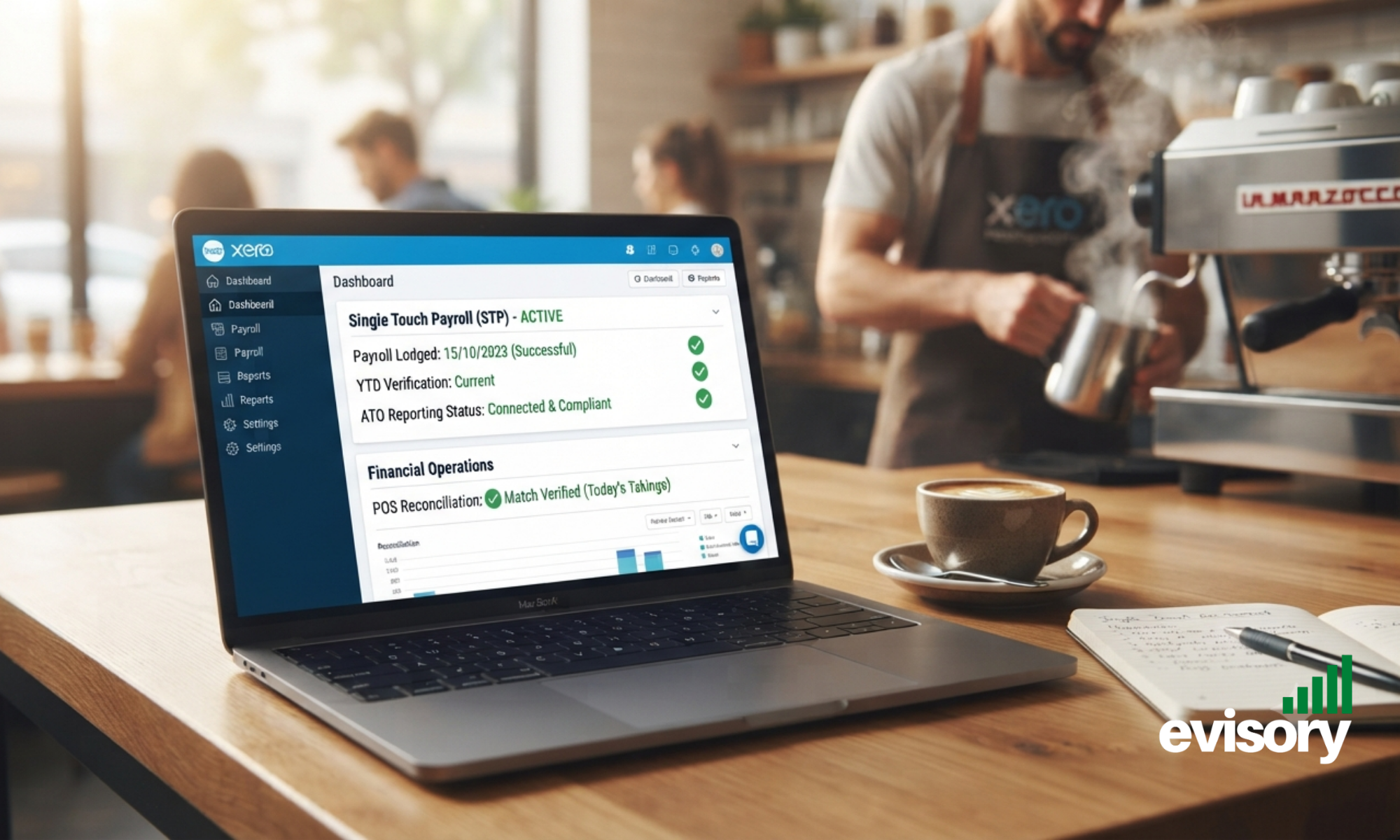
Close-up of automated payroll compliance and sales reconciliation tools tailored for Australian hospitality.
BAS, GST and STP make the outsourcing decision far more about compliance than convenience. If your venue is GST-registered, BAS lodgement is mandatory, and if you have employees, tax and super reporting must go through STP-enabled software.
The Tax Practitioners Board treats payroll services involving the interpretation and application of tax law, including STP reporting, as BAS services. That means outsourced payroll is not just admin when it includes tax treatment. A common misconception is that STP stops mattering once payroll is outsourced. It does not. The obligation still exists, and the software and process still need to be right.
This matters because hospitality labour is both large and volatile. According to the ABS quarterly tourism labour statistics, cafes, restaurants and takeaway food services accounted for 210,200 jobs in March quarter 2026, while clubs, pubs, taverns and bars accounted for 44,200 jobs. Over that quarter, jobs fell by 5,600 and 2,200 respectively. When staffing moves around that much, payroll controls need to be stable even when rosters are not.
Highlighted quote stating that if bookkeeping touches payroll, STP, GST, or BAS, the choice is really between two risk profiles.
"Evisory includes payroll processing and stocktake and inventory management in its hospitality bookkeeping offering."
For venue owners, the practical lesson is simple. If the bookkeeping job touches payroll interpretation, STP, GST or BAS, you are no longer choosing between two admin options. You are choosing between two risk profiles.
Is outsourced bookkeeping cheaper than hiring in-house?
Outsourced bookkeeping is often cheaper once you count the full cost of an internal hire, not just salary. For a hospitality venue, the real comparison includes leave, recruitment, training, software, supervision and error-correction time.
In-house looks cheaper when you compare a monthly fee against wages alone. That is rarely the whole picture. Internal staff need backup coverage, documented processes and enough technical depth to handle BAS, payroll and reporting during busy periods. If they do not, managers end up doing finance cleanup after hours.
Outsourcing is not automatically cheaper for every venue. A large multi-site group with daily finance volume may justify an in-house team. Yet many single-site and small-group venues benefit from fixed-price support because costs are more predictable and the work does not stop when one person is away.
A useful test is this: if your owner, venue manager or head chef is still chasing timesheets, correcting supplier coding or explaining unexplained POS variances at month-end, your current model is already costing more than the fee line suggests.
How do you assess whether your venue should outsource bookkeeping?
Start by assessing risk, not preference. For a cafe, pub or restaurant, the right decision comes from payroll complexity, reporting speed and how much operational rework your current process creates.
Step 1 is to map the pressure points. Look at the last three months and identify where time or money was lost: late pay runs, unreconciled POS batches, supplier statement mismatches, overdue BAS tasks or poor visibility on wage percentages.
Step 2 is to measure transaction complexity. A venue with split shifts, weekend penalties, multiple revenue centres, gift cards, delivery platforms and bar stock adjustments needs more than generic bookkeeping. If the sales system and bank deposits rarely match cleanly, POS reconciliation should move high on the list.
Step 3 is to decide what truly needs to stay in-house. Managers should usually keep approvals, roster sign-off and issue escalation. Specialist bookkeeping, month-end close, BAS preparation and structured management reporting can often move out with little downside and a lot more consistency.
How do you move from in-house to outsourced bookkeeping without disrupting trade?
A clean handover is very achievable if the venue locks systems, cleans opening data and runs one controlled transition cycle. Xero, MYOB and common POS platforms all support this well when responsibilities are clear.
Step 1 is to confirm the source of truth for each data stream. Decide which system owns sales, payroll, supplier bills, banking and inventory. Do not let the same transaction be edited in multiple places during cutover.
Step 2 is to clean the opening position. That means unreconciled bank items, payroll liabilities, super balances, GST codes, supplier statements and chart-of-accounts mapping should be checked before the first outsourced month starts. A common misconception is that a new provider will fix historical mess automatically. The better approach is to quarantine old issues and agree how they will be resolved.
"Evisory includes POS reconciliation, bank reconciliation, cashflow analysis and management reporting in its hospitality bookkeeping service."
Step 3 is to run a short parallel process for the first pay cycle and first month-end. Managers keep approving hours and supplier payments, while the outsourced team tests payroll outputs, POS-to-bank matching and reporting format. That is usually enough to catch coding issues before BAS or wage reporting is affected.
Step 4 is to set a reporting rhythm. Weekly flash reporting is particularly useful in hospitality because it shows wage pressure and cash movement before month-end closes. This is one area where Evisory’s Brisbane hospitality focus can be useful for operators who want faster local support and one point of contact rather than a generic ticket queue.
How do you choose the right outsourced bookkeeping provider for a hospitality venue?
Choose a provider with BAS capability, hospitality system knowledge and a reporting process you can actually use. A good fit should understand POS reconciliation, payroll awards and cashflow, not just reconciliations.
Step 1 is to verify credentials and scope. Ask whether the provider is a registered BAS or tax agent for BAS services, who handles payroll, and how STP and super obligations are managed. If the answer is vague, keep looking.
Step 2 is to inspect the month-end method. Ask how they reconcile POS sales to bank deposits, how supplier credits are treated, how delivery platforms are cleared and when management reports are issued. Hospitality numbers are only useful when the clearing accounts are clean.
Step 3 is to test communication. You want direct contact, practical explanations and a fixed reporting timetable. If you run a cafe or bistro with a bar in Brisbane or South East Queensland, Evisory is a specialist option worth comparing because it combines hospitality bookkeeping, accounting, payroll and profit-focused advisory in one local structure.
When should a venue keep some bookkeeping in-house and outsource the rest?

A strategic hybrid model review meeting demonstrating how on-floor operations connect with outsourced technical expertise.
A hybrid model is often the smartest answer for hospitality venues. Venue teams keep the operational inputs, while a specialist provider such as Evisory handles the technical, recurring and compliance-heavy work.
This works well because many tasks depend on being on site, while others depend on specialist finance discipline. A manager should approve timesheets and explain unusual wastage. A hospitality bookkeeping team should turn that information into payroll accuracy, reconciled sales data and decision-ready reports.
Keep in-house: Staff hour approvals, cash count sign-off, stocktake participation, supplier issue escalation and trading commentary.
Outsource: BAS preparation, payroll processing, STP reporting, POS reconciliation, bank reconciliations, month-end close and cashflow reporting.
Review together each month: Wage percentage, gross profit by category, unexplained till variances, unpaid supplier trends and upcoming BAS or super liabilities.
If your current setup leaves managers buried in admin or owners waiting too long for clean numbers, a hybrid arrangement is usually the fastest practical fix. For cafes and bistros with a bar, that often means keeping venue control where it belongs and moving the technical bookkeeping burden to a specialist hospitality accounting firm that can support stronger cashflow and clearer decisions.